Search This Blog

Wednesday, September 28, 2011

10 Reasons Why People with Autism ROCK.

...reposted from National Learning Concepts, who have a ton of great content and products on their site!


1. People on the autism spectrum don't play mind games
Sarah: “I'm going to have a cozy day at home honey, but whatever you decide to do is fine.”
Mike: “Great. I think I'll head on over to Greg's house to watch the game and have a few beers.”
Sarah: “Fine! You might as well sleep over there too since the locks will be changed by the time you get home.” (Exits room and slams door)
Mike: (Frowning, confused and totally nonplussed) “What the..?”

Typical people are often masterful at saying one thing, while meaning the opposite. It's a game that most of us hate but we play it anyway. Consistently needing to read between the lines can be emotionally exhausting. Why is it so difficult for most of us to simply say it straight? People on the autism spectrum don't play these mind games. They tell it like it is and it's remarkably refreshing to be in their company. They don't expect you to play these games either. They mean what they say, and expect you do too. That's right! They'll take what you say at face value, without secretly doubting or disbelieving your word. What a great characteristic!

2. People on the autism spectrum are not interested in “looking good”
Many of us have an unconscious need to impress others. The clothes we wear, the topics we talk about, and even the careers we pick are often influenced by what others might think of us. People on the autism spectrum tend to do what makes them happy. If those ugly red shoes provide great comfort, then so be it. If reading children's comics make them laugh like a little kid, that's what they'll do. They're not about to feign interest in some philosophical argument just because it might make them look good. They're not interested in keeping up with the neighbors or buying the new “in thing” because that's what everyone is doing. They are who they are and that is that! This makes them genuine, sincere people who are unique and fascinating to be around.

3. People on the autism spectrum maintain an innocence about them
Many people on the autism spectrum have an uncanny ability to maintain the innocence of a little kid. They are captivated by the small things in life and are likely to be far more impressed by a leaf blowing haphazardly in the wind, than by the worldly possessions someone is flaunting in front of them. Foreigners to deception, they believe every word you say and this characteristic leaves them as gullible and naïve as a child. They don't look for hidden meanings and even if they did, they are unlikely to find them. They accept the world at face value, often delighting in the beauty around them.

4. People on the autism spectrum are honest
Since deception is not part of their makeup, people on the autism spectrum hardly ever tell a lie. One might even say they are honest to a fault. People on the autism spectrum will call it as they see it. If you want the truth, you know who to go to but be prepared for a brutally honest answer. Most of this population has never perfected the art of a white lie. They typically do not cheat or steal and remain remarkably in integrity. Most often people on the autism spectrum are valued friends who are honest, forthright and one hundred percent loyal.

5. People on the autism spectrum delight in the moment
For many of us, the book we found fascinating in college wore off pretty fast. The jingle that first made us laugh drove us crazy 20 minutes later. The first sunset we witnessed captivated our heart but years later we put on sunglasses and barely notice it. Sadly, it doesn't take much for us to become blasé about the world around us. Most people on the autism spectrum are just the opposite! The joke that had them in stitches a month ago has the same effect on them today. The light reflecting off the glass window has them just as mesmerized as they first time they saw it. The color of the sky after a summer storm fills them with wonder each and every time. Perhaps because they are so sensory aware, they possess the talent of delighting in the small moments of life. One thing is for sure, their enthusiasm for life is contagious and it's great to be in their presence.

6. People on the autism spectrum have an intense ability to focus
While the rest of the world is socializing, many people on the autism spectrum are pursuing their interest with frenzy. There are no limits to the amount of time and effort they will dedicate to their passion, and they possess a unique ability to filter out the rest of the world while doing so. This intense focus and attention to detail enables them to master a subject or skill, which is often a great asset to the workforce. Temple Grandin says that if we eradicate autism from the world, we'll also be depriving ourselves of all the great gadgets and technology we enjoy, such as software programs, computer chips, video technology and the likes. While many of these inventors and pioneers might not be diagnosed with autism, many of them certainly possess autistic traits and the ability to focus intensely on their subject of interest.

7. People on the autism spectrum don't gossip
You know those people who are always talking behind your back? You can be sure they are not on the autism spectrum. People on the spectrum do not indulge in gossip. In fact the whole thing goes right over the top of their head. And as for all those private smirks and eye contact people surreptitiously engage in during a public exchange, you can bet your spectrum friend will never do that to you. If your spectrum friend has something to say, he'll either say it directly or keep it to himself. Blabbing about it to other people is completely foreign to his nature.

8. People with autism are not judgmental
Wouldn't it be great if people could just accept you as you are? The answer is to befriend someone on the autism spectrum. People with autism concentrate on the matter at hand. When they're listening to you speak, this is where they maintain their focus. They won't be furtively judging you on your clothes, your level of success, the color of your skin or how well you play baseball. If Jim tells his autism spectrum friend that he likes eating burgers from McDonalds, his friend thinks “Jim likes eating burgers from McDonalds.” He doesn't judge Jim based on his eating preferences or secretly concludes that Jim has poor eating habits, and is in need of an education on the food pyramid. The same holds true when a person on the spectrum encounters someone, who, let’s say for example has pink hair. There is no judgment about what type of personality this person must have or the background they must have come from. They simply acknowledge the presence of pink hair and move on. The ability to abstain from jumping to conclusions about people based on their appearance, career or some other aspect is admirable, and we have much to learn from our friends with autism in this department.

9. People on the autism spectrum make great employees
Many people on the autism spectrum make great employees with admirable work ethics. They are typically creatures of habit. They arrive at exactly the same time every day and never leave early. They wouldn't dream of taking extended lunch breaks and you won't find them socializing at the coffee machine. They're more likely to be working studiously at their desk. Many of us balk at the routine aspects of our job and overlook the small details we should pay attention to. But this is often an area of strength for those on the spectrum, who are masterful at paying attention to detail. They are honest and loyal workers, who certainly don't enjoy job hopping and are typically committed and dedicated to their place of employment.

10. People with autism have a unique perspective
People with autism have a unique way of communicating and a fascinating perspective. Many are capable of such a diverse range of exceptional abilities. If you take the time to look, you'll find that the amount we can learn from them is quite staggering. Because people with autism have such a different way of thinking and being, they can contribute greatly to us, the workforce and to how we view life. If you are lucky enough to be close to someone on the autism spectrum, you will know firsthand that not only do they see the world from a different angle, but they have changed your perspective too and instilled in you a sense of compassion you never knew you were capable of feeling.

To all of you out there who are on the autism spectrum...You Rock!

By Jené Aviram

This article is property of and copyright © 2011 Jené Aviram of Natural Learning Concepts. Reference of this article may only be included in your documentation provided that reference is made to the owner - Jené Aviram and a reference to this site http://www.nlconcepts.com
Jené is an accomplished author and developer of education materials for children with autism and special needs. She is a co-founder of Natural Learning Concepts, a leading manufacturer for special education materials and autism products. Visit the Natural Learning Concepts website at http://www.nlconcepts.com or call             (800) 823-3430      
 

Friday, July 8, 2011

Crazy things you'll hear at my house

When you have kids, you say things you never thought you'd hear yourself say. When you have kids on the spectrum, you honestly can't believe the things you need to say sometimes!

Here are just a few of the winners I've come out with over the last few days:
  • "Please stop killing things."  (This morning, in response to the genocide of ants on the porch, which horrified his older brothers.)
  • "Put the bat down!"
  • "We don't hit Mommy."
  • "Please stop eating your clothes."
  • "Sweetie, put down the knife!"
  • "Please put your pants back on."

There are a million more. You probably have some gems, too. Feel free to share.

Tuesday, April 19, 2011

Growing Up Aspie

We had a Passover Seder at my parents' house last night, and my cousin and his wife came in from the other side of the state. My cousin is 46 years old and has Aspergers. He is so much like my nine year old in so many ways, and I feel really blessed to have him in our family - not just because he's one of the smartest, kindest people I know, but to have someone else with Aspergers in the family is really helpful. He's able to help us understand our son better, and - although our oldest son has no idea he has AS - he absolutely idolizes my cousin. Probably because he's the only person in the world who knows more about snakes than our little guy!

Anyway, my cousin made this statement last night that I have to immortalize here. He was telling us what it was like for him, growing up an Aspie in an affluent suburb of NYC.

"It was tough," he said. "Other kids were into sports and Star Wars.  I was into car washes."

See why I love him so much?

Wednesday, April 13, 2011

Autism, Hope, and Jenny McCarthy

Thanks to some extra Audible.com credits, I downloaded Jenny McCarthy's books "Louder than Words: A Mother's Journey in Healing Autism" and "Mother Warriors: A Nation of Parents Healing Autism Against All Odds."

I can tell you that my expectations for these books were not high. I had seen Jenny's article in defense of Dr. Andrew Wakefield, maintaining that there is a link between vaccines and autism. I had heard her incredible claims that kids were recovering from autism. And...she was Jenny McCarthy, a B-list celebrity and former Playmate. Why would I have anything BUT low expectations?

But, my curiosity got the better of me, and I used those bonus credits on Jenny McCarthy instead of Ayn Rand. (Seriously, that WAS my consideration set!)

And I have no regrets.

First, I'll say this: Jenny McCarthy is an awesome story teller. Don't let the blond hair and ginormous boobs fool you - this woman can write. She is passionate, funny, and surprisingly articulate. She had me hooked from the first minutes of  "Louder than Words." (Credit must go to narrator Tavia Gilbert, as well - she's fab.)

The story of Jenny's struggle to recover her son Evan from autism is tragic, but inspiring. It had me counting my blessings - I'm so fortunate that our boys never suffered from seizures as Evan did. We never had to hospitalize them for anything relating to their autism. Apart from their asthma and Ig's chronic ear infections, our kids have been in good health. She had to watch her baby go into cardiac arrest before her eyes. I can't even fathom what that was like.

Question all you like Jenny's decision to pursue alternative biomedical treatments. She offers disclaimers left, right and center, and credits ABA, speech therapy and OT for Evan's improvements as much as anything else.   It also has to be clarified that she is not anti-vaccine, although this has been broadly publicized. She questions the vaccine schedule. She questions the cookie-cutter approach we take to delivering all vaccines to all children on this accepted schedule. And she questions the use of thimerosal in vaccines. I'm not anti-vaccine, but I have to admit, I've questioned all these things too. Why are Gardasil and Chicken Pox vaccines mandatory in some states? How did the flu vaccine, which is predictive and has a history of quality control issues, become mandatory for preschoolers? And if thimerosal isn't problematic, why are there thimerosal-free vaccines (and why the hell aren't they covered by insurance?)

What I love about Jenny McCarthy is that she delivers hope. Sure, GFCF diets and B12 shots won't work for all kids with autism...but they might work for some. What's the harm in trying alternative treatments that are safe, non-invasive and inexpensive? Especially if you can get you pediatrician on board to help you monitor. Why not try to gain some control over something that's taken over your life and your child's, if it can only help?

Jenny McCarthy made me realize that I had accepted Ig's autism as inevitable. This is how he is. This is how he will be. We'll do ABA and speech, and OT if we can afford it. We'll try to get him into an appropriate school. Hopefully, this will help him improve. Then we won't have to worry about him running into the street or disappearing at recess if he's mainstreamed at school.

When I pictured Iain in the future, I saw someone  who probably wouldn't be able function independently in the world. Ever.

I'd accepted. And in acceptance, I'd become complacent.

Jenny made me realize I don't have to accept. I can do more. I can change the outcome. I have power. I can help my little boy become typical - better than typical. I can help him put that bright little mind to use in a way that will help him achieve the greatness I know he can!

I don't know that we'll get into hyperbaric chambers and chelation.... but we're starting a GFCF diet soon, for Ig, his oldest brother and me, if not for our whole family. And I'm researching supplements, too. Baby steps...and we'll see how it goes, documenting every step we take.

So... you may think she's a quack, you may think she's a ditz, you may think she's the devil, but I owe a lot to Jenny McCarthy. She gave me hope I didn't even know I needed.

Wednesday, April 6, 2011

Ig's not feeling well

Ig: (Big sigh) "Mom...I'm not feeling well."
Mom: "You're not feeling well?"
Ig: "No."
Mom: "I'm so sorry, Sweetie! What hurts?"
Ig: "My feelings hurt. My feelings hurt, so I'm not feeling well."

Friday, November 5, 2010

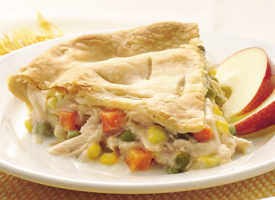
Chicken Pot Pie

What's dinner like at your house?

We're a family with two working parents. My husband and I both work in New York City, which, while it's less than 20 miles east, makes for a 90 minute commute in either direction. By the time we get home, the best we can do is pull something from Trader Joe's out of the freezer, throw it into a skillet, serve it, and leave the pan in the sink until the next morning.

For us, eating together is a priority. It's not just all those stats about how your raise smarter kids with better attitudes towards food when you eat as a family. It's that dinner time is the only time we have together every day when everyone is sitting - and the TV is off. It's that short break between throwing the food together and the blur of homework/baths/bedtime. It's when I should hear about everyone's day, see everyone's faces. It's time to be a family.

But it never quite works out that way.

Tuesday, I worked from home. There was no school. I had seen a recipe for chicken pot pie in some magazine, and although I'm a longtime vegetarian now, I remembered how much I loved it as a kid. So I figured I'd make it for my family. I had ordered groceries online (FreshDirect delivers to our neighborhood now. Woot!) so I included chicken legs and crescent roll dough in the order. I put the chicken and other ingredients in the slow cooker in the morning. I rolled out dough for the crust. I actually PLANNED a meal. I can't remember the last time I PLANNED a meal!!

So we sat down to dinner.

  • I don't think Oz (typically developing middle child, age 6) took one bite - if that - before rejecting the meal.
  • Ig. (age 4, PDD-NOS) looked at plate, shoved across the table, screamed "NO!" and demanded pasta.
  • B, (9, Aspergers) must have seen the look on my face, compensated for everyone else's rudeness, and declared this his favorite meal ever. He ate his and everyone else's.

Did I think this was going to be different from any other meal? When I make fish sticks (which take 5 minutes) I'll get this reaction if they're the wrong shape!

All we want is this peaceful 20 minutes with our family every night, but it rarely happens. Usually it's Ig's doing - he either doesn't like the entree, doesn't like where he's sitting, or has some inappropriate toy with him at the table. This will always result in Ig screaming, throwing something, hitting someone, or whipping something with his blanket. On the worst nights, my husband will lose it and scream at him, and will put Ig in time out. Ig does not like time out, and will usually scream or kick the chair for the full 4 minutes.

While Ig is the predictable and typical disrupter of meals, Oz often contributes by reacting and screaming at his brother. And Bryn will act as the third parent, saying things like "Oz, that's inappropriate!" And we ultimately descend into chaos.

The best nights are the ones when I give in and order pizza or make macaroni and cheese.Then, there are no fits or screams from Ig, unless I put his juice in the wrong cup or something.

But I don't want to give in every night. I want my kids to eat multi-colored foods. I want them to eat protein (although I'd be happy if they chose to go veg with their mama!), along with whole grains and bright-colored vegetables. This is what I try to serve them every night. And I want them to sit, enjoy their healthy meal, and tell me how school was.

Is it so much to ask? 20 peaceful minutes and a healthy meal?

Thursday, October 21, 2010

Pants

It's October, officially autumn. Leaves are turning orange, the sky is a bright cobalt blue, and the air has a slight chill to it. We're all happily pulling on our jeans and sweaters and hading out to pick apples and pumpkins.

All, that is, except for Ig.

Ig will not wear pants, at least not voluntarily. Ig, for the last three weeks, has been fighting me tooth and nail every single morning because he wants to wear shorts. He doesn't like long pants. Left to dress himself, he will appear in the living room wearing pull-on shorts, a t-shirt and sandals, despite the fact that the outside temperature is 55 degrees.

Every day, it's a battle. We'll pick out clothes the night before, and I'll often compromise and let him pick out a short-sleeved shirt to wear with the super-soft track pants I bought him. But when the morning comes, the fight ensues. 

I took the proactive measure of hiding all his shorts, which you'd THINK would have been effective. But no. The morning after I did this, Ig dressed himself in short pajama bottoms with a favorite t-shirt. Then he dug a pair of shorts out of a Goodwill bag.

For a few days, the morning battles were reduced in intensity because we agreed that Iain could wear the pajama shorts when he got home from daycare. Fair enough.  Unfortunately, after about 5 days of wearing them (he will pull them out of the hamper), they absolutely needed to be washed! And as a working mother with three boys, I am, admittedly, not always on top of the laundry. The shorts are still waiting to be washed. Ig is not pleased. 

Yesterday, I attempted to reward/bribe my son for putting on a pair of jeans. I told him if he put them on, he could have a lollipop. (Yes, it was 7:00 AM, but a mom's gotta do what a mom's gotta do!)  First, he held the jeans up to his waist, in front of him, and asked for the lolli. Nice try.  Then,he actually did put them on, but said "he wasn't ready" to go to school, because he didn't want to wear long pants. For about the thousandth time this month, I tried to explain that:
  • We need to wear LONG pants when it's cold. 
  • Look, Mommy's wearing long pants!
  • Let's look at "The Snowy Day" (again). See the snow? It's cold, right? Is Peter wearing shorts? No! Peter's wearing (say it with me!) LONG PANTS!
...But to no avail. 

There was endless crying. And Ig's cry, in situations like this, is almost identical to an infants cry - but with the power and volume of a four-year-old.

I offered him his lolly for keeping the pants on. "I don't want a lollipop! I want a push-up pop!" "But honey, we don't have any push-up pops. And I offered you a lollipop." "NO!!!"

Okay, so we left without the lollipop. Not that leaving was so easy. There was still resistance, screaming, continued crying. I cut my losses and let him wear crocs (forbidden in both daycare and preschool) and threw his sneakers and a hoodie into his backpack. Totally not worth the fight, when those could easily be addressed by the daycare staff.

Once we were about a block away from the house, Ig realized that he hadn't gotten his lollipop. Nevermind that he hadn't *wanted* it. The crying, at this point, turned to SCREAMING. Nearly ten minutes in the car (because, natch, we hit every possible red light), with a screaming child in the back seat. Nightmare. A friend pointed out that if a police car had pulled up beside me, it's very likely that I would have lost custody of my child. It sounded that bad.

He was still nearly hysterical when I brought him into daycare. Fortunately, for once, they caught on and pried him off me. Good thing, too - I had barely 10 minutes to catch my bus to work! I kissed him goodbye, knowing he'd be fine in a few minutes.

Anyhow....fortunately, our ABA therapist came last night. Needless to say, we asked her to spend a little time talking about this with him!